Faraj Survives Two Missile Strikes in Lebanon; Khalil Dies an Hour Before Rescue
A 21-year-old photojournalist was pulled from rubble on 22 April after a colleague was killed in an attack the Israeli military said targeted ceasefire violators.
By Javier Morales ·
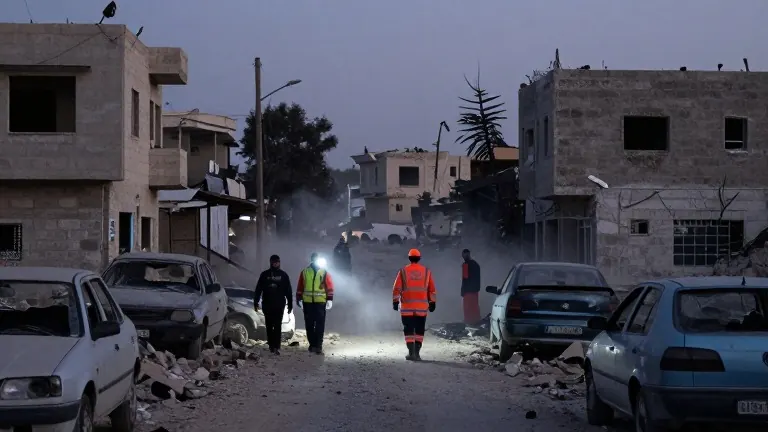
Zeinab Faraj, a 21-year-old photojournalist, was pulled from under rubble in southern Lebanon on 22 April after a series of strikes that killed the reporter beside her. Faraj and Amal Khalil, 42, had driven to the village of al-Tiri that afternoon to document damage from the war that preceded a ceasefire agreed in mid-April.
The pair had met earlier that day at Tebnine governmental hospital, a site people used as a staging point because it was considered relatively safe. Ahead of their vehicle was a car carrying Ali Nabil Bazzi, 27, a municipal official in Bint Jbeil, and Mohammed Hourani, 37, a friend of the mayor. Both men were killed when a missile struck their car.
Faraj said she did not hear the missile. She heard Khalil scream and saw the car in front of them catch fire. Drones then arrived overhead, she said, flying low and close while the two women called emergency services for help.
A paramedic on one call told them to drive back up the road because ambulances could not reach them. As they moved toward their car, a missile hit it and threw both women backward. They took shelter in a nearby house, where Khalil had visible injuries to her face, hand and leg.
Faraj sent her sister a message before her phone died: "There's no hope left. Forgive me." The two sat on a bathroom floor. Faraj said she crawled to a position to watch the road, and a drone descended toward her.
A later strike brought the house down around them. Faraj awoke under weight she could not lift, barely able to breathe. A paramedic reached her and held her shoulders while another cleared the rubble. As drones returned, they pulled her free and drove her to a hospital.
At the hospital, nurses first tried to reassure Faraj about Khalil, then fell silent. "That's when I knew she was gone," Faraj said. Khalil is believed to have died about an hour before paramedics were permitted to return to the area to retrieve Faraj.
The Israeli military said it had identified saboteurs violating the ceasefire. Human rights groups called the strike a war crime. Messages urging a rescue operation reached the military while the two women sheltered in the building. A week before the attack, an Israeli military spokesperson circulated video of Khalil from her newspaper and labeled it "terrorist media". Khalil had also received death threats from Israeli numbers.
Faraj, who was freelancing while finishing a degree in radio and television, was raised in Bint Jbeil, near al-Tiri. She said her life had centered on the area. "My whole life revolved around this area. As we say, a fish suffocates when it's taken out of water. That's how we feel whenever we leave Bint Jbeil."
As of 26 October, Faraj is preparing to return to university. She has visible injuries to a hand, limited movement in one eyebrow, and a limp that makes stairs difficult. She wakes at night screaming, and the sound of drones and warplanes leaves her on edge. The image of Hourani on the ground after the first strike stays with her: "His head was turned towards me. His eyes open and looking at me. That is something I will never get out of my head."
Faraj was trapped under rubble for the period before paramedics reached her, and Khalil died about an hour before the medical team was allowed back into the area.
Source: The Guardian